The Starch Factor: What White Linen Actually Does to a Dining Room
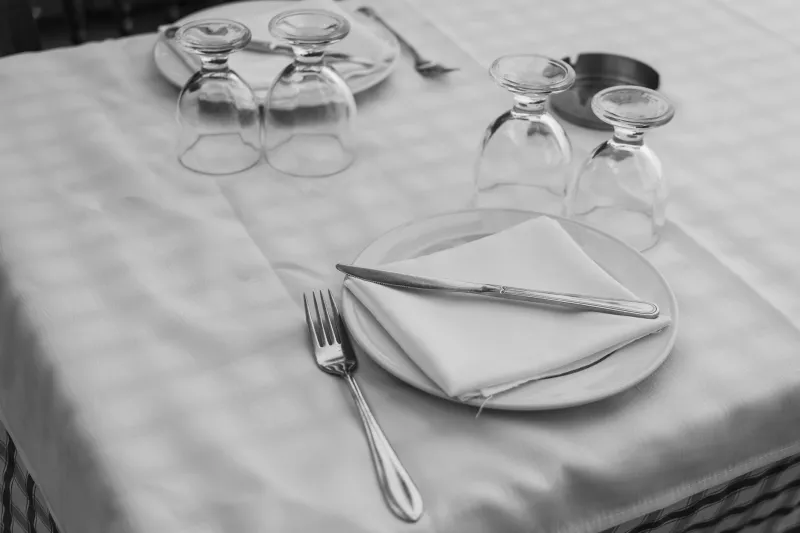
There is a moment, just before service, when the dining room is still quiet and the lights are not quite up. A member of our front-of-house team takes a folded white cloth, gives it a practised snap, and lets it settle over a bare table. The room changes. It is not a grand gesture. Nobody applauds. But the table stops looking like a surface and starts looking like an invitation.
That moment is what I keep coming back to when people say the tablecloth is old-fashioned. It is not old-fashioned. It is a piece of quiet theatre, and like most good theatre it works best when you barely notice it is happening.
The first thing you notice, even when you don't
Ask diners to describe a restaurant and they will talk about the food, the lighting, the noise. They rarely mention the cloth. But put them at a bare table and then at a linen-covered one and watch what happens to their hands. On bare wood, people spread out. They put keys down, phones down, elbows down. On white linen, the hands become a little more deliberate. The phone stays in the bag a beat longer. The menu is picked up rather than grabbed.
At Othello, we lay white linen for dinner because it does a job that no amount of exposed brick can do. It sets a boundary between the outside world and the meal. It says: this is not the kitchen counter, not the train seat, not the desk. This is an occasion, even if the occasion is simply that you have decided to eat properly on a wet Tuesday in November.
A speed limit for supper
One of the less obvious effects of a proper cloth is that it slows the pace. I do not mean it makes dinner last three hours. I mean it puts a small, useful pause into the evening. The table is set. The napkin is folded. The cutlery has a place. You sit down and the room asks you to settle before you order.
In the UK we have become very good at the quick dinner. We can eat in forty minutes and be back on the pavement before the coffee goes cold. There is nothing wrong with that, and we are not here to police anyone's diary. But a white tablecloth makes the quick dinner feel like a choice rather than a habit. It gives the meal a beginning, a middle and an end. It is a speed limit, not a roadblock.
The posture effect is real
I am not going to pretend that linen makes people sit up straight like a school assembly. But it does something adjacent. It makes diners feel that the room has made an effort, and most people respond to effort with effort of their own. They lean in. They pass the bread more carefully. They ask the person opposite what they are having rather than ordering at the screen.
That is not snobbery. It is atmosphere. A restaurant is a collection of small signals, and the cloth is one of the clearest. It tells you that someone has thought about your evening before you arrived. In a country where the mid-week meal out can so easily blur into a refuelling stop, that signal matters.
Not nostalgia — theatre
There is a temptation to frame this as a longing for the old days, when every restaurant had a maître d' and a silver trolley. That is not the argument. Some of the best meals in Britain are eaten at bare tables, and some of the worst are eaten under starched napkins. The cloth is not a guarantee of quality. It is a stage set, and stage sets are only as good as the performance on them.
But that is exactly why it is worth keeping. At Othello, we are interested in the whole performance: the welcome, the way the menu is presented, the pace of the room, the small rituals that tell you dinner has begun. White linen is one of those rituals. It is not there to make you feel underdressed. It is there to make the evening feel dressed.
The laundry problem, and why we keep going
Let's be honest about the practical side. White cloth is expensive. It stains. It needs washing, pressing, replacing. A restaurant that chooses linen is choosing a daily chore. There are easier ways to run a dining room, and plenty of operators have taken them. The no-cloth look is cheaper, faster and, in many cases, very handsome.
We still lay the cloth because the chore is part of the point. The effort is visible in the result. When you sit down at a table that has been properly dressed, you are sitting at the end of a process that started hours before you arrived. That is not nostalgia. That is hospitality.
What the cloth asks of you
A white tablecloth makes a small request. It asks you to treat the table as a table, not a storage unit. It asks you to stay for pudding. It asks you to put the phone away and look at the person you came with. It is a gentle piece of choreography, and most people are happy to follow it.
So no, we are not giving up the linen. Not because we are stuck in the past, but because we think the present could do with a little more of this particular kind of fuss. The room looks better. The pace feels better. The evening becomes something you remember rather than something you got through.
And if you spill a little red wine on it? Well. That is what the cloth is for.