Chalk Dust and Impulse: The Pull of the Unprinted Dish
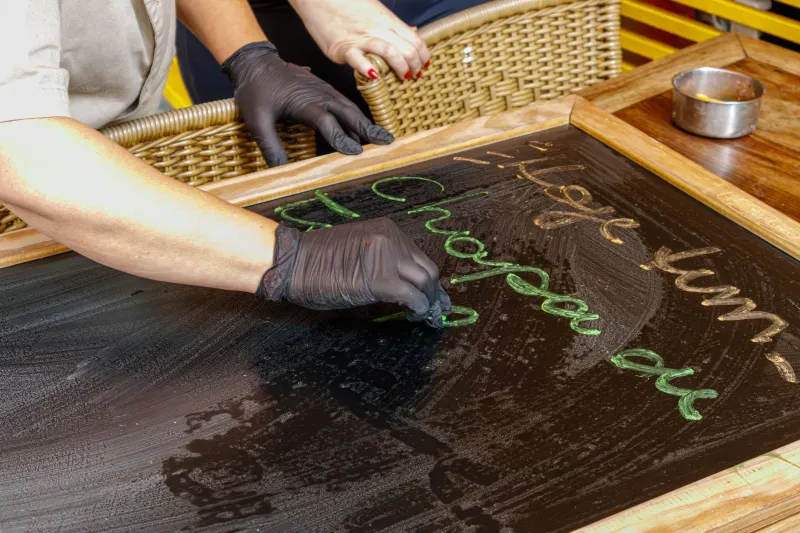
You come in out of the cold, and before anyone has offered you a drink, your eyes have already gone to it. A board propped against the wall. White chalk on black, a bit smudged at the corner where somebody's sleeve caught it. A dish you didn't know existed four seconds ago, and now cannot quite imagine ordering anything else.
That's the whole trick, and it isn't really a trick at all. The printed menu is a promise; the board is a message. One was written weeks ago for everyone. The other was written this morning for you.
The menu is a contract, the board is a conversation
A printed menu is a fine thing. We've argued for it before, and we'd argue for it again—there is a particular pleasure in holding a menu in your hands, reading it properly, taking your time. But a printed menu is a settled document. It went to the printer in a batch of two hundred. Its paper stock was chosen. Somebody proofread it. It cannot possibly know that the greengrover had a glut of celeriac on Tuesday, or that the fishmonger rang at half seven this morning with something better than what was ordered.
The board knows. That's the difference. It's the one part of the restaurant that is genuinely live, updated in the gap between service and service, in handwriting that belongs to a specific human being with a specific temperament. You can tell a lot about a kitchen from its chalkmanship. Neat, ruled columns suggest a certain discipline. A wild diagonal scrawl with an arrow and an exclamation mark suggests something else entirely, and usually something delicious.
Scarcity does the rest
Here's the psychology, laid bare: we want what is finite. A dish on the printed menu will be there next week, and probably the week after. A dish on the board might not survive the evening. It says so, sometimes, in six words: until we run out. Four portions left. Back next year.
None of that is manufactured scarcity, at least not in a kitchen worth its salt. It's just the truth of cooking with what actually turns up. Game season doesn't negotiate. Mussels arrive in the quantities the boats bring them in. The last of the crab is the last of the crab. When you order off the board you are, in a small way, eating at a particular moment in a particular year—and by the following November, that exact plate will not exist again.
There's something quietly thrilling about that, and something faintly sad, in the way that all good meals are faintly sad.
A direct line to the pass
Every restaurant has a layer of translation between the kitchen and the table. The board shortens it. Somebody in chef's whites wrote those words with their own hand, in their own accent, with their own opinions about how much chilli is enough. There's no marketing team between you and the pan.
This is why the board tends to be blunter than the menu. Our printed dishes get the full treatment—the sourcing, the region, the story. The board gets a line and a half, sometimes less. Partridge, bacon, cavolo nero. Scallops, brown butter, capers. It reads like a note passed across the pass rather than a paragraph composed for a customer, and that informality is precisely what makes it persuasive. You feel as though you've been let in on something rather than sold something.
At Othello, that instinct runs deep. Our menu travels the old spice routes between Venice and Cyprus, and the board is where that map gets redrawn weekly according to what the UK actually has in November. Venison from the estates. A crate of something interesting from the market. The last of the season's shellfish. It's the same kitchen, the same palate, but a different conversation.
The small social gamble of ordering off-piste
Ordering from the board is also a tiny act of self-definition. It says: I'm not here for the safe choice. I asked a question. I listened to the answer.
It's a low-stakes gamble, and that's part of the appeal—the mild, pleasant risk of a dish you haven't researched, in a dining culture that increasingly encourages us to read the menu online before we've put our coat on. There's no photograph. No review. Just a description and your own judgement, which is a muscle most of us don't use often enough.
And here's the thing about the gamble: it almost always pays. The board exists because a chef got excited about an ingredient, and excitement is a reliable predictor of effort. Nobody writes a dish on a chalkboard at nine in the morning out of obligation.
How to order from it properly
A few small habits make the whole exchange better.
Ask what's nearly gone. It's not an impertinent question—it's the correct one. You'll get a straighter answer than any menu could give you, and occasionally a recommendation you weren't expecting.
Ask what's in it if the line is cryptic. Partridge, bacon, cavolo nero is a haiku, not a spec sheet. Your server knows the rest.
Don't treat it as the starter's consolation prize. The board is not the overflow. On a good night it's the sharpest thing in the building.
Order it before you've decided on the printed menu. Not superstition. Just arithmetic. The printed dish will still be there in ten minutes.
The last line of chalk
There is a small ceremony at the end of a night when the board gets wiped down—a damp cloth, a smudge, gone. Tomorrow it will say something else. That's not a flaw in the system. That's the whole point of it.
So next time you're in, and the board is leaning against the wall with something on it you don't quite recognise, do yourself a favour. Read it before you sit down. Ask about it. Order it. Let the unprinted dish have its evening.
It only gets the one.