Beyond the House Red: Reading a Wine List Without Panic
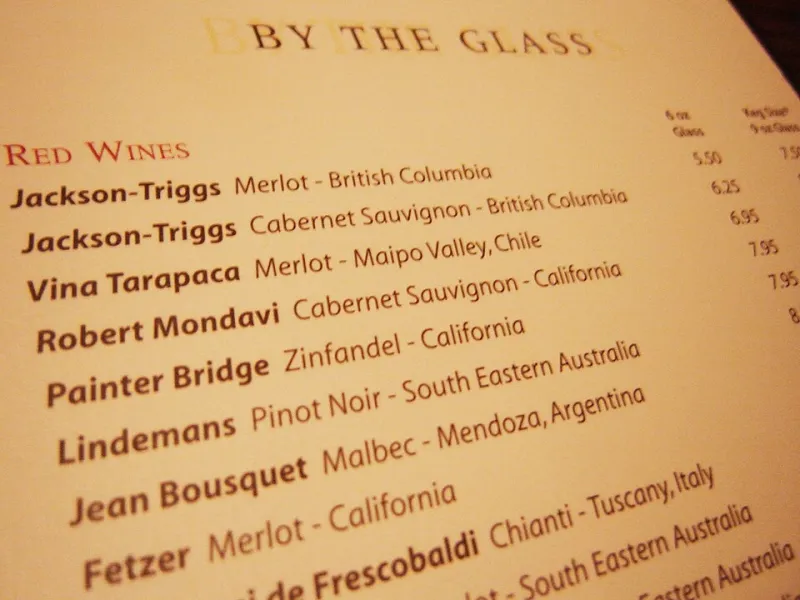
Photo: Iwona Erskine-Kellie, CC BY 2.0, via Wikimedia Commons
There are two kinds of people in a restaurant when the wine list arrives. The first opens it with the calm of someone reading a familiar newspaper. The second holds it at arm’s length as if it might bite. Most of us are somewhere in between, defaulting to the house red because it is easier than admitting we do not know what a Grüner Veltliner is supposed to do.
That is a shame. A wine list is not a test. It is a script. The grapes are the protagonists, the regions are the supporting cast, the vintages are stage directions. You do not need to know every line. You just need to know what kind of story you want the meal to tell.
Start With the Shape of the List
Before you read a single grape name, look at how the list is built. Is it arranged by region, by grape, by style or by price? Are there sections for sparkling, whites, reds, pinks, sweet things and fortified things? Is there a decent by-the-glass selection, or is the list mostly bottles?
This matters because it tells you how to use the document. A list sorted by region is asking you to think geographically: do you want something from Burgundy, the Loire, Sicily, Spain? A list sorted by grape is asking you to think about flavour: do you want something crisp, aromatic, juicy, savoury? A list sorted by price is asking you to relax and pick a number. None of these is better than the others. They are just different scripts.
At Othello, we like a list that can be read in two directions. If you know you want something white and brisk, you can find it. If you know you want something red and generous, you can find that too. If you know nothing at all, there is a short by-the-glass section that does the thinking for you.
Grapes Are the Leads
If you remember one thing about wine, make it this: grape varieties are more useful than brand names. A Sauvignon Blanc from New Zealand and a Sauvignon Blanc from the Loire will not taste identical, but they will share a family resemblance. A Pinot Noir from Burgundy and a Pinot Noir from Oregon are cousins, not strangers. If you know you like the lead, you can enjoy the production.
The same goes for the regions. A region is not a guarantee, but it is a clue. Chablis usually means a lean, steely Chardonnay. Rioja usually means Tempranillo with a savoury, oak-aged edge. The Mosel usually means Riesling with sweetness and a spine of acidity. If you are ordering in a UK restaurant and you see English sparkling wine on the list, give it a fair hearing. It is often excellent, and it is a nice bit of local casting.
Vintages are stage directions. A hot year can make a wine richer and rounder. A cool year can make it leaner and more acidic. But unless you are ordering something serious and expensive, do not let the year scare you. The restaurant has already chosen the bottle. Your job is to choose the mood.
Phrases That Do the Work
Here is the secret that good waiters wish more people knew: asking for help is not a failure. Bluffing is. You do not need to pronounce every appellation. You do need to tell the person with the list what you are eating and what you usually enjoy.
Try one of these:
- ‘We are sharing the fish and the mushroom risotto. What would you open with that?’
- ‘We would like a bottle around £35 that will not overpower the food.’
- ‘Could you steer us towards something by the glass for the first course?’
- ‘We are not experts. We would rather ask than guess.’
- ‘Is there something on the list you are particularly proud of?’
That last one is a gift. It gives the sommelier or waiter permission to guide you towards something interesting, rather than simply upselling the most expensive thing. It also makes the exchange feel like a conversation instead of a transaction.
And please, do not order the second cheapest bottle just to avoid looking mean. Restaurant wine lists are not a moral hierarchy. The cheapest bottle is not automatically bad, and the most expensive is not automatically right. A good bottle is one that has a job and does it well.
Pace, Not Just Pairing
Most wine advice is about pairing. That is useful, but it misses the bigger picture: a bottle shapes the pace of the meal. A high-acid sparkling wine wakes up the palate and makes the first course feel like an event. A light, chillable red can keep a lunch moving. A big, tannic red can slow everything down, which is lovely if you have ordered a long, slow braise and terrible if you have ordered a delicate fish.
If you want a bottle to last the whole meal, choose something in the middle. A medium-bodied white, a soft red, a dry rosé. If you want the meal to build, order by the glass at the start and move to a bottle later. If you want the wine to be the main event, order fewer courses and give it your full attention.
At Othello, we often tell people to think about the bottle as a member of the cast. It does not need to be the star. It needs to fit the scene. A crisp white with a starter, a juicy red with the main, a small glass of something sweet with pudding — that is not complicated. That is just good staging.
The Casting Call
When the list arrives, take a breath. Read the headings. Find a grape you like. Ask a question if you need to. You are not being tested. You are casting a bottle for a meal that is already in progress.
And if you still cannot decide, say so. ‘We are stuck between these two’ is one of the most useful sentences in a restaurant. It gives the staff something to work with, and it usually gets you a better bottle than the one you would have picked in a panic. The best wine list is not the longest one. It is the one you feel comfortable reading.