Twelve's Company: The Art of Dining in a Crowd
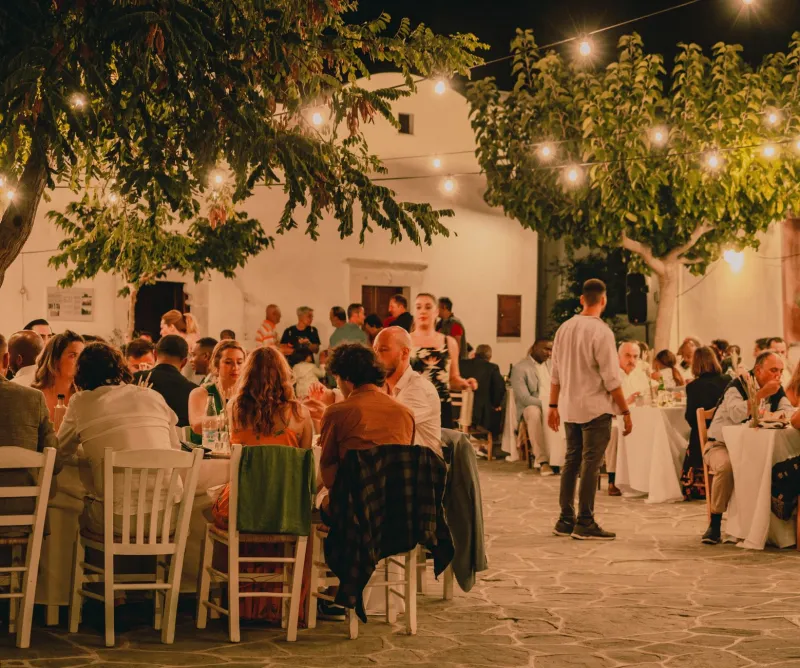
There is a particular moment, about ten minutes before a table of twelve sits down, when a restaurant changes gear. The room is still the room. The lights are still the lights. But the table itself has become a small stage, and everyone approaching it is suddenly aware that the evening will not be measured in quiet conversation and shared glances. It will be measured in noise, movement, second helpings and the delicate business of getting a large group fed before anyone starts negotiating for the bread basket.
At Othello, we like a big table. We also know that a big table is not simply a normal dinner enlarged. It has a different pulse. It asks different questions of the kitchen, the floor team and, frankly, the guests. Treat it as a stretched version of dinner for two and you end up with a long wait, a confused order and someone at the end of the table who has been nursing a lukewarm drink since the starters. Treat it as its own event and the whole night lifts.
The table changes the weather
A party of two can whisper. A party of twelve has weather. There is a front of the table and a back. There are side conversations, private jokes, someone explaining the menu to someone else, and at least one person asking whether the sea bass is “the fish one”. This is not a problem to be solved. It is the point. But it does mean the host has a job: to give the table a shape.
That shape can be as simple as deciding, before anyone arrives, whether this is a long, languid dinner or a sharper, more theatrical one. A birthday table wants a rhythm. A work table wants clarity. A family table wants enough food on it that nobody has to guard the last potatoes. The menu can do a lot of this work, but only if the booking is treated as a proper brief rather than a number in a diary.
Ordering is a group project, and that is fine
When a table gets large, the ordering moment can become a committee meeting. One person wants to start with oysters, another is avoiding shellfish, a third has decided to be vegetarian at 7.02pm, and someone’s plus-one is quietly hoping nobody notices they have not opened the menu. None of this is a disaster. It just needs a plan.
Our advice is to lean into the group project rather than fight it. Collect dietary needs before the night, not at the table. Choose a handful of dishes that can be shared or passed, so nobody feels pinned to a single plate while the other end of the table gets something more interesting. And give the table a clear starting point: a round of something cold, a few plates for the middle, a simple instruction about how the first twenty minutes will run. People relax when they know what is happening.
Pre-ordering is not surrender
There is a strange idea that pre-ordering a large table is a failure of spontaneity. In practice, it is usually the opposite. A pre-ordered table spends less time reading and more time talking. The kitchen can pace the meal properly. The floor team can time the drinks. And the guest who always orders last, after everyone else has closed their menus, gets to skip the pressure of holding up twelve people.
This does not mean the evening has to be rigid. At Othello, we would rather build a menu with a few fixed anchors and a little room to move than pretend a table of twelve can order à la carte with the casual ease of a couple. A set menu is not a cage. It is a script with space for improvisation. The best big-table dinners have both.
Build the menu in waves
A large table cannot be treated as twelve individual plates arriving in perfect sync. It can, however, be treated as a series of waves. Something to open the appetite. Something to pass. A main course that lands together enough to feel like a shared event. A pudding that gives the table a final reason to lean in. The pleasure comes from the sequence, not from everyone receiving exactly the same thing at exactly the same second.
This is where sharing plates earn their keep. They give a big table something to do with its hands. They create small conversations. They make the table feel generous rather than administrative. The trick is to choose dishes that still look like themselves when passed along a long table — robust, clear, not too delicate to survive a journey past eight people and a candle.
Service has a choreography
A table of twelve is a piece of service choreography. The team is not just carrying plates; it is reading the room. Is the table ready for the next course, or is someone mid-story? Has the toast happened yet? Is the wine moving fast enough to justify another bottle, or is the table still settling? These are small judgments, but they are the difference between a smooth evening and one that feels like a relay race with cutlery.
The guest’s part is simpler: arrive together if you can, tell the team who is hosting, and let the restaurant do the counting. A good big-table dinner relies on trust. The kitchen trusts the floor to read the pace. The floor trusts the host to flag the speech, the cake, the dietary curveball. And the table trusts that nobody has been forgotten at the far end.
The bill, the toast and the graceful exit
Eventually, someone will ask for the bill, and the table will discover that splitting it is a sport in itself. Decide early how it will work. One payer, a simple split, or a collection with a little grace for the person who organised it. The less time spent doing arithmetic at the end, the more time there is for the bit everyone actually remembers: the toast, the laughter, the last spoonful of pudding, the coats being gathered while somebody insists on one more photograph.
A dinner for twelve is not a quieter version of a dinner for two. It is louder, looser and more unpredictable. It is also, when it works, one of the great pleasures of eating out: a table that turns the room into a party without losing the thread of the meal. The long table has its own rules. Learn them, and the evening takes care of itself.